 Ambience player & focus timer

A calm room for your screen: ambience playlists, gentle effects, slow visuals and a timer.
Focus Room plays Soundscape Atlas ambience scenes as a playlist with smooth crossfades, shapes them with a master equalizer, room reverb and stereo width, and fills the screen with slow, seamlessly repeating generative backgrounds. A Pomodoro, 52/17 or custom focus timer rings gentle chimes, a sleep timer fades everything out, and a local session log shows your week as a heatmap. Nothing plays until you press Play, and nothing leaves your device.
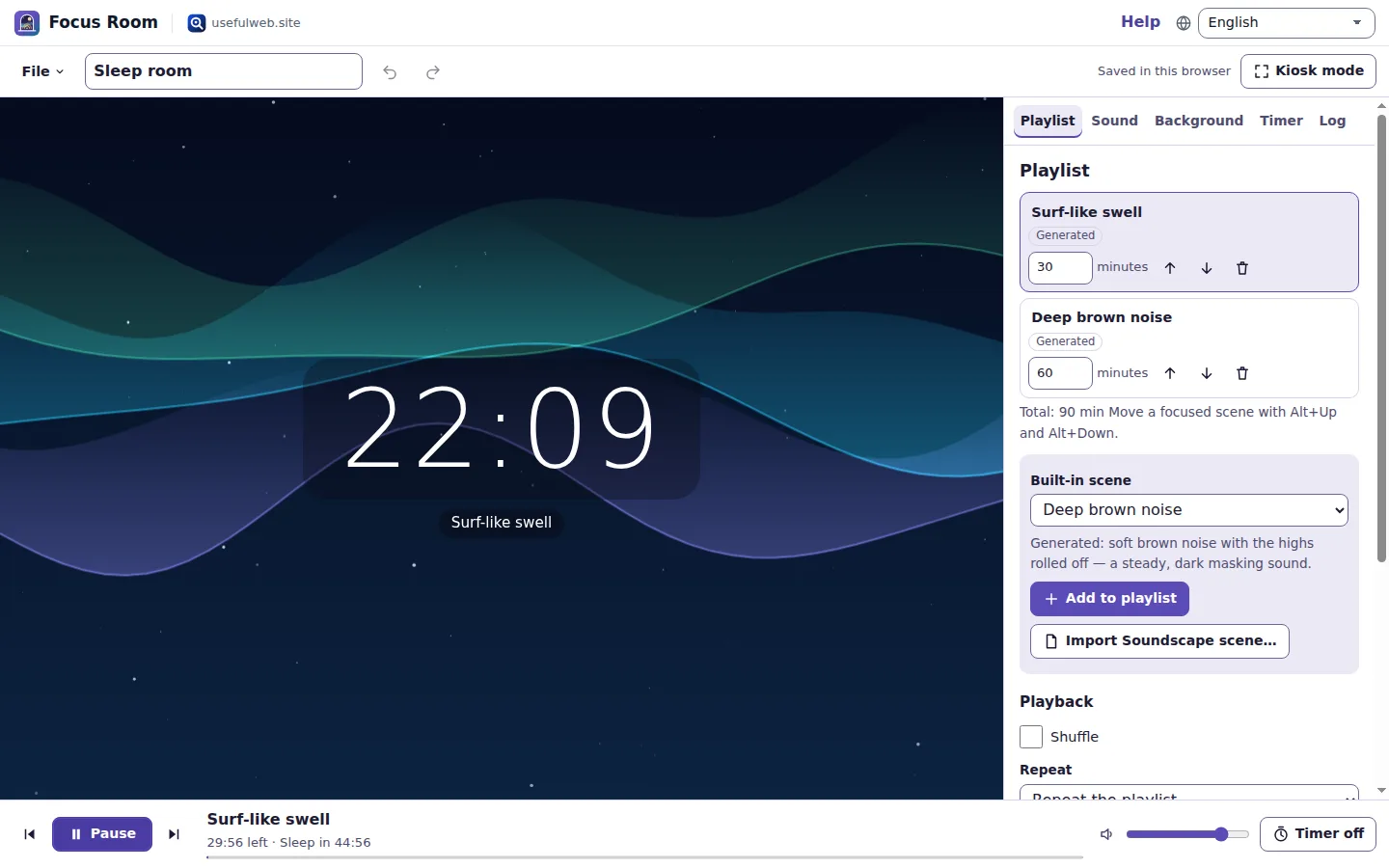
Screenshots
- A playlist of scenes over a slow background
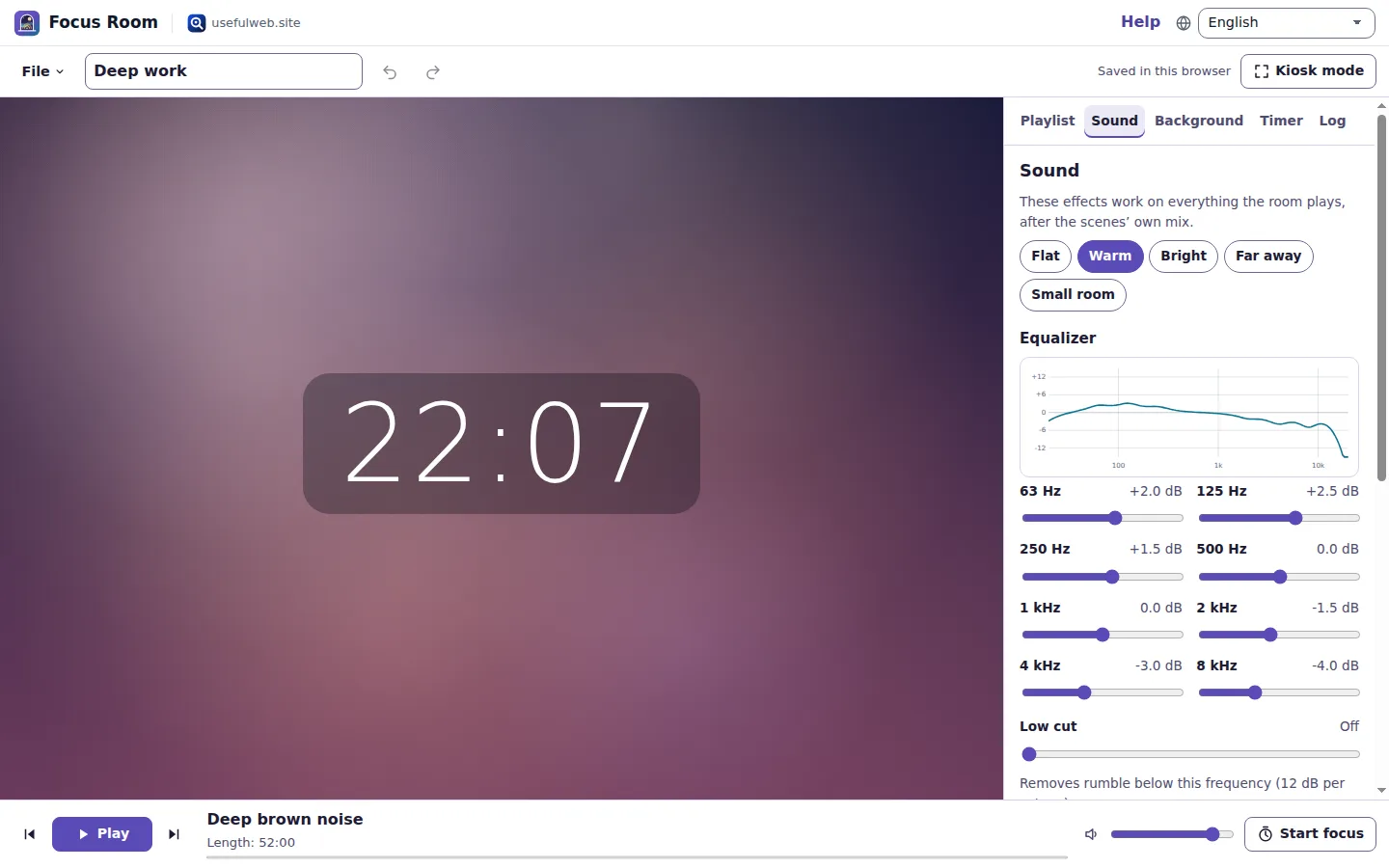 Master effects with a live EQ curve
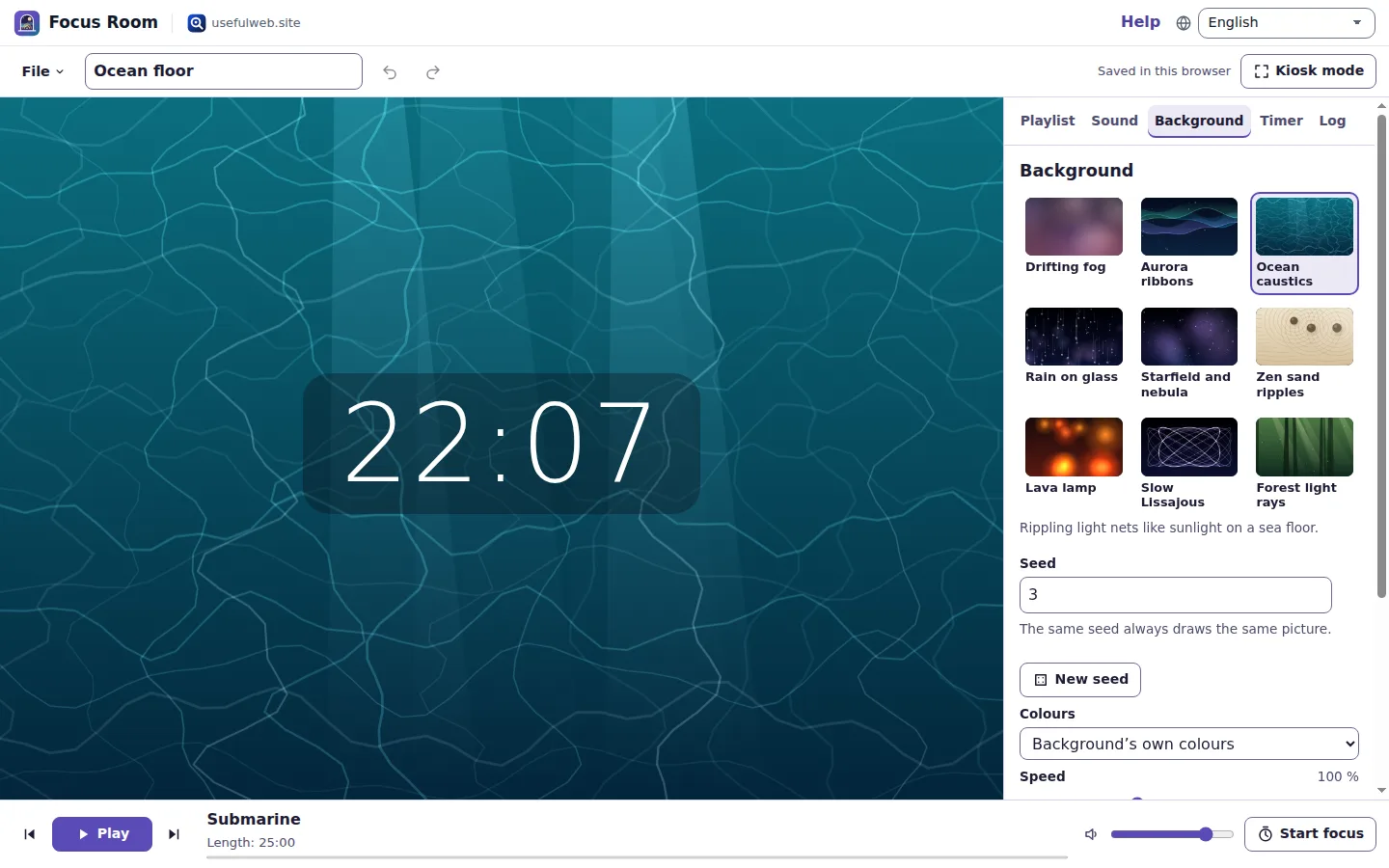 Nine generative backgrounds
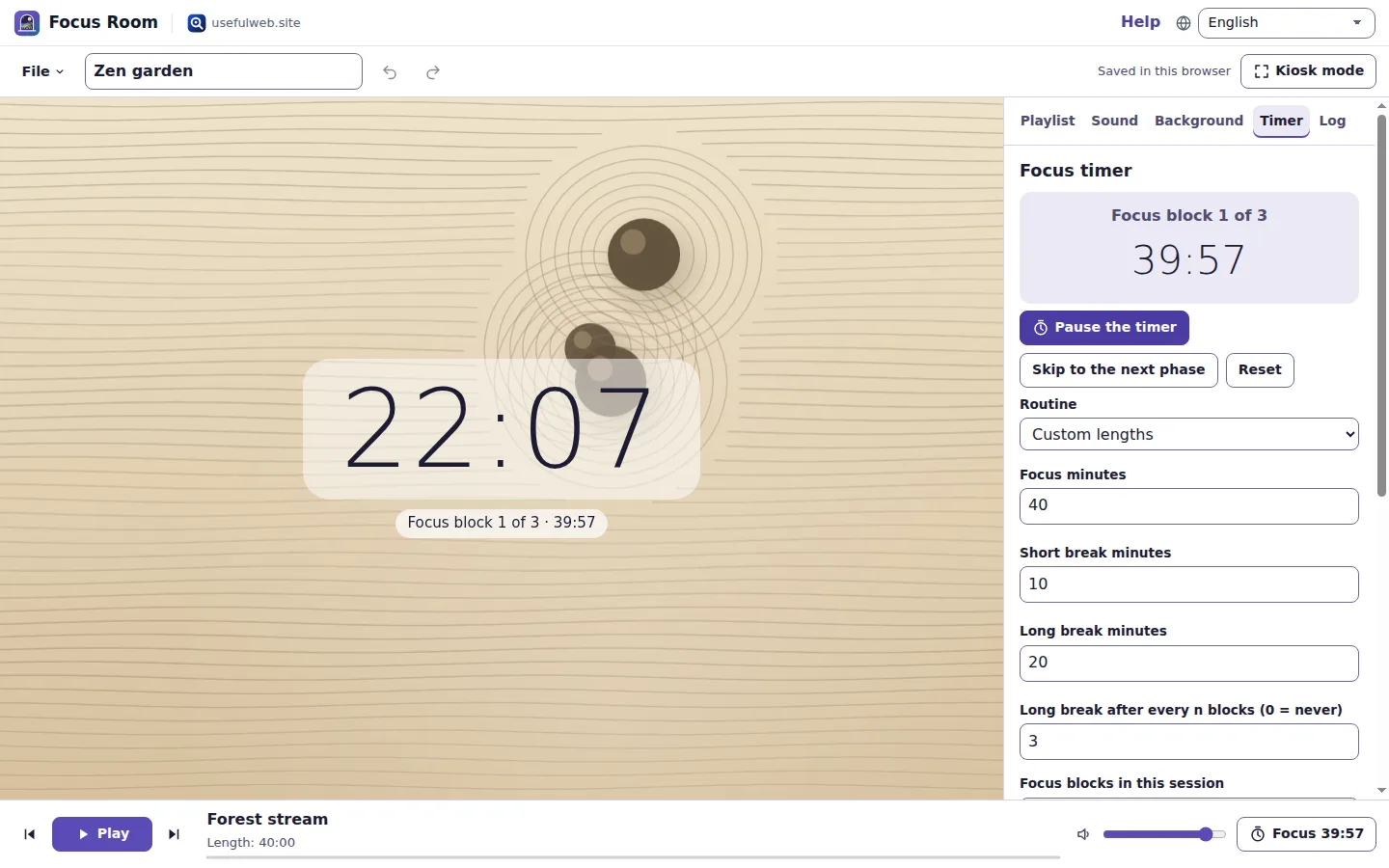 Focus timer with gentle chimes
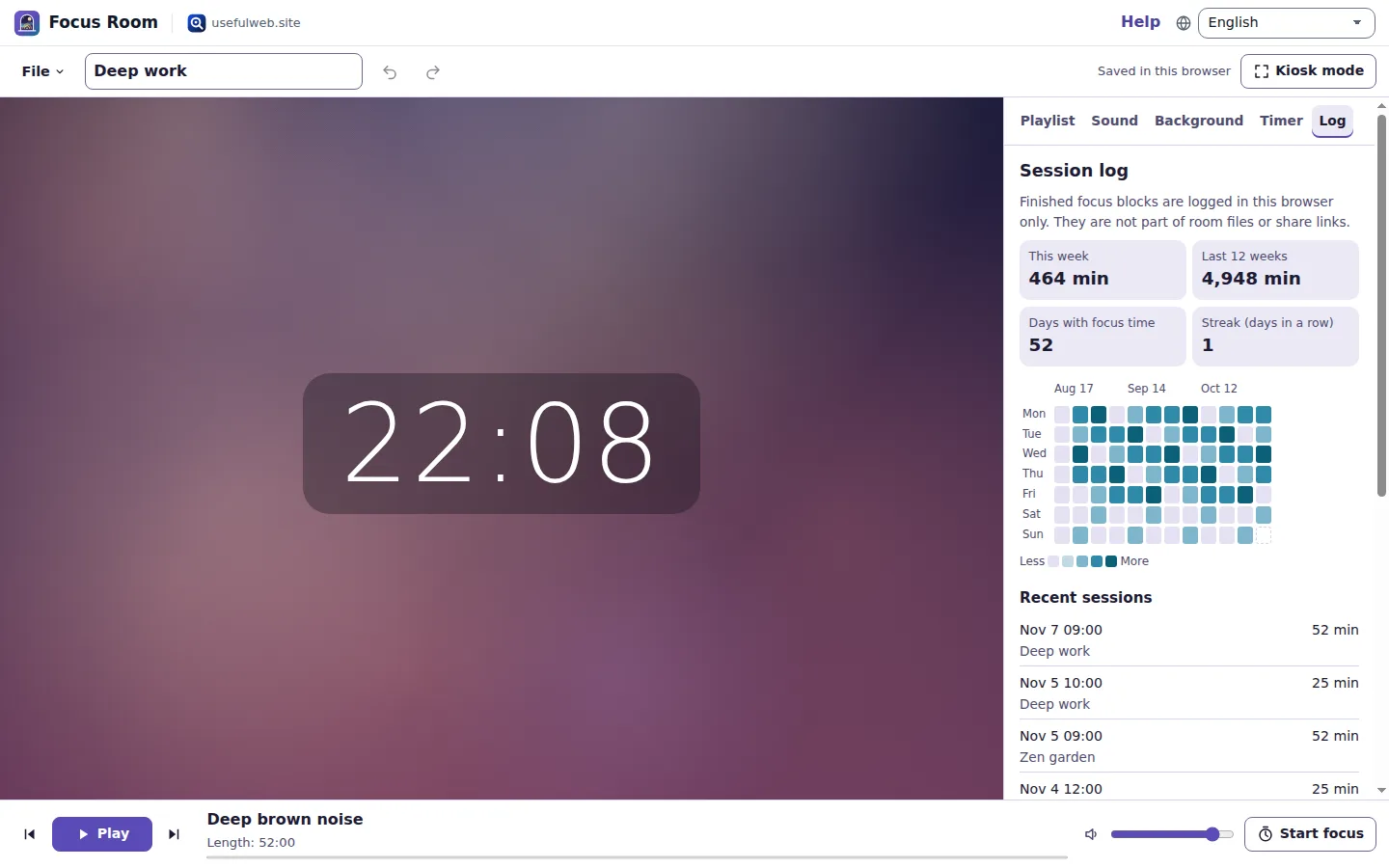 Your week as a heatmap
Features
Ambience playlists
Put scenes in order with their own lengths, then shuffle, repeat one or all, and move them with buttons or Alt+arrow keys.
Equal-power crossfades
One scene melts into the next over 0 to 30 seconds with constant loudness — the same curve in the player and in the WAV render.
Seventeen built-in scenes
Brown noise, light rain, a surf-like swell, a fireside and the Soundscape Atlas worlds — generated sounds play offline, real Commons recordings stream when played.
Scenes from Soundscape Atlas
Open .soundscape.json files or press “Open in Focus Room” in Soundscape Atlas: your own mixes become playlist entries, with their credits.
Graphic EQ and cuts
Eight octave bands from 63 Hz to 8 kHz, low cut and high cut, with a live response curve computed from the same filters the browser runs.
Room, width and limiter
Place everything in a small room, a hall or a cave, widen or narrow the stereo image, and keep peaks soft with a gentle limiter.
Sound presets
Warm, Bright, Far away and Small room set every effect at once as a starting point; undo brings back what you had.
Nine generative backgrounds
Drifting fog, aurora ribbons, ocean caustics, rain on glass, a starfield, zen sand, a lava lamp, Lissajous curves and forest light rays — each loops without a seam.
Seeds, themes and calm motion
Every background is drawn from a seed in one of eight colour themes, at a capped frame rate; with reduced motion it shows slowly crossfading stills.
Kiosk mode
Full screen with a large clock, controls that hide themselves, a screen that stays awake while it plays, and Esc to leave.
Focus timer with chimes
Pomodoro, 52/17 or your own cycles with soft bell chimes, an optional quieter sound during breaks, and a calendar file of the plan.
Sleep timer
Fade the whole room out over the minutes you choose, then stop.
Session log and heatmap
Finished focus time is logged in this browser and shown as a twelve-week heatmap with your streak; export it as CSV or clear it.
Render to WAV
Mix the playlist with its crossfades and effects into a WAV file on your device — the same renderer as the playlist tool.
Private and local
Rooms autosave with recent rooms, undo and redo, room files and share links; the session log never leaves the browser.


Templates
Start from a ready-made project and change it to fit.
Deep work
Brown noise, a rainy study and pink rain in 52-minute blocks with 17-minute breaks, warm sound and drifting fog.
Pomodoro café
Four 25-minute Pomodoros with a café-like murmur, a fireside and light rain, rain on glass in front of city lights.
Ocean floor
A submarine, surf-like swells and cavern drips under rippling caustics, sounding far away.
Zen garden
A forest stream and a night wind over raked sand, with 40-minute focus blocks and 10-minute breaks.
Night shift
Spacecraft hum, night wind and deep brown noise under a slow starfield, bright EQ, 52/17 blocks.
Sleep room
Surf-like swells and brown noise that fade out after 45 minutes, under aurora ribbons. No focus timer.
Forest with real recordings
Soundscape Atlas worlds with real Wikimedia Commons recordings — a Bavarian dusk and an alpine brook — between forest light rays.
Built-in tools
Focus Room uses these tools. Each one also has its own page and works on its own, in the browser, through the JSON API and through MCP.
- Focus Room Playlist Renderer Focus Room engineMix a playlist of generated ambience scenes with crossfades and master effects into a WAV.
- Focus Room Focus Timer Planner Focus Room enginePlan Pomodoro, 52/17 or custom focus blocks and export them as a calendar file.
- Ambience Generator (rain, wind, stream, fire, hum, drone) Focus Room engineSynthesize rain, wind, water, fire, room hum or a drone as a seamless-loop WAV.
- Noise Generator (white, pink, brown) Focus Room engineMake white, pink, brown, blue or violet noise as a WAV file and check its spectrum.
- Room Reverb for WAV Files Focus Room engineAdd room, hall, cathedral or cave reverb to a WAV file with a known reverberation time.
For AI agents
Focus Room runs on a deterministic engine. The same functions are available as tools with a JSON API and MCP, so scripts and AI agents get exactly the results the app shows.
- Focus Room Playlist Renderer – Mix a playlist of generated ambience scenes with crossfades and master effects into a WAV.
Tool page ·POST https://focusroom.usefulweb.app/api/v1/tools/focusroom-playlist-render/calculate· MCPfocusroom_playlist_render - Focus Room Focus Timer Planner – Plan Pomodoro, 52/17 or custom focus blocks and export them as a calendar file.
Tool page ·POST https://focusroom.usefulweb.app/api/v1/tools/focusroom-focus-timer/calculate· MCPfocusroom_focus_timer - Ambience Generator (rain, wind, stream, fire, hum, drone) – Synthesize rain, wind, water, fire, room hum or a drone as a seamless-loop WAV.
Tool page ·POST https://focusroom.usefulweb.app/api/v1/tools/soundscape-ambience-generator/calculate· MCPsoundscape_ambience_generator - Noise Generator (white, pink, brown) – Make white, pink, brown, blue or violet noise as a WAV file and check its spectrum.
Tool page ·POST https://focusroom.usefulweb.app/api/v1/tools/soundscape-noise-generator/calculate· MCPsoundscape_noise_generator - Room Reverb for WAV Files – Add room, hall, cathedral or cave reverb to a WAV file with a known reverberation time.
Tool page ·POST https://focusroom.usefulweb.app/api/v1/tools/soundscape-reverb/calculate· MCPsoundscape_reverb
- MCP endpoint (Streamable HTTP):
https://focusroom.usefulweb.app/mcp - Project file format (JSON Schema): https://focusroom.usefulweb.app/project.schema.json
- OpenAPI description: /openapi.json · llms.txt · API & MCP
Build a project through the API, then open it in the app with a link to https://focusroom.usefulweb.app/app#project=<base64url JSON>.
Import & export
Import
- Focus Room room (.focusroom.json)
- Soundscape Atlas scene (.soundscape.json, file or App Bridge)
- Share link (#project=)
Export
- WAV (16-bit stereo, playlist with crossfades and effects)
- Focus Room room (.focusroom.json)
- Calendar file of the focus plan (.ics)
- Session log (.csv)
- Credits of the recordings (.txt)
- Share link
Keyboard shortcuts
| Keys | Action |
|---|---|
| Space | Play or pause (when no button has focus) |
| N | Next scene |
| P | Previous scene |
| T | Start or pause the focus timer |
| K | Kiosk mode on or off |
| G | Next background |
| 1 … 5 | Open Playlist, Sound, Background, Timer or Log |
| Alt + Up / Alt + Down | Move the focused playlist scene |
| Esc | Leave kiosk mode or close a dialog |
| Ctrl + Z | Undo |
| Ctrl + Shift + Z | Redo |
| Ctrl + S | Save room file |
| Ctrl + O | Open a room or scene file |
| ? | Show keyboard shortcuts (single-key shortcuts can be switched off there) |
Frequently asked questions
Will Focus Room start playing by itself?
No. Sound only starts when you press Play or test a chime. Opening a room, a template or a link never plays anything.
Where do the sounds come from?
Most scenes are generated on your device by the Soundscape Atlas audio engine from a seed: noise colours, rain, wind, water, fire, hum and drones. Some Soundscape worlds and your own Soundscape scenes contain real field recordings from Wikimedia Commons; those stream from upload.wikimedia.org when they play, and the credits list them.
How do I bring my own Soundscape mix in?
In Soundscape Atlas choose File → Open in Focus Room, or save the scene as a .soundscape.json file and open it here with Ctrl+O. It becomes a playlist entry. Audio you imported into Soundscape Atlas stays in that app and is left out.
What does equal-power crossfade mean?
While one scene fades out and the next fades in, their gains follow a cosine and a sine curve. The sum of their powers stays constant, so two different ambiences neither dip nor bulge in loudness during the change.
Do the backgrounds use a lot of power?
They are drawn at 15, 30 or 60 frames per second (30 by default) at screen resolution, and pause in background tabs. With reduced motion the app shows still images that crossfade every 20 seconds instead.
What is stored about my focus sessions?
Only the date, start time, focused minutes and room name of each finished block, in this browser. The log is not part of room files or share links. Export it as CSV or clear it in the Log panel.
Why does the screen stay on?
In kiosk mode Focus Room asks the browser for a screen wake lock while it plays, so the display does not sleep. It is released when you leave kiosk mode, pause or switch tabs.
Can I use the rendered WAV in my own videos?
Generated scenes are yours to use. If a rendered playlist contains Wikimedia Commons recordings, follow their licences: the credits list each recording with its licence and author.
Limitations
What Focus Room does not do (yet):
- Playback follows the browser’s audio clock; phones may pause audio and timers in background tabs or with the screen off.
- Crossfades are triggered by a page timer: in background tabs a change can start up to about a second late.
- The limiter is a soft clipper (tanh knee), not a look-ahead broadcast limiter; very loud mixes can still sound compressed.
- Recordings come from Wikimedia Commons and need a connection; the server playlist tool renders only generated scenes.
- The WAV render is limited to 12 scenes and 10 minutes; long rooms are rendered with shortened scenes.
- Wake lock and full screen depend on the browser; some browsers ignore them or ask first.
- The session log lives in this browser only and is not part of backups made with room files.
- Generated scenes imitate rain, surf or a café with filtered noise; they are not recordings of those places.
Tutorials
Learn Focus Room step by step.
- Your first focus room in five minutesOpen a template, press Play, start a Pomodoro and learn the parts of the Focus Room workspace — stage, panels and player.Beginner 5 min
- Playlists and crossfadesAdd built-in scenes, set their lengths, reorder them with the keyboard, shuffle or repeat, and choose how long one scene melts into the next.Beginner 7 min
- Shape the sound with EQ, room and widthUse the sound presets, the eight-band equalizer with its response curve, low and high cut, room reverb, stereo width, volume and the gentle limiter.Intermediate 8 min
- Backgrounds and kiosk modeChoose one of nine generative backgrounds, change its seed, colours and speed, show the clock, and turn a second screen into a calm full-screen window.Beginner 6 min
- Focus timer, chimes and your session logRun Pomodoro, 52/17 or your own cycles with gentle chimes, quieter breaks and a calendar file, then read your week in the session heatmap.Beginner 7 min
- Soundscape scenes, WAV and sharingBring your own Soundscape Atlas mixes into a playlist, render the playlist to a WAV file, credit the recordings, and share a room as a link — also from the API.Intermediate 8 min
Ready to try it?
Other premium apps
-

Twinworks
Factory digital twin & production simulation
Model a production line, simulate it and find the bottleneck — free, in your browser.
-

Lumina
Photo editor & image toolkit
Bring out what you saw. A free photo studio, right in your browser.
-

Soundscape Atlas
Sound map & ambience studio
Find real field recordings on a world map and mix them into calm, editable soundscapes.
-

RavingDesk
Paper trading & data workspace
Practise trading on paper and chart your data: orders, risk, datasets, analyses, reports.
-

Flipline
Drawing, storyboards & animation
A few drawings. A little life. Make a flipbook in your browser.
-

Ledgerly
Household finance & life-admin desk
Budgets, bills, subscriptions, loans, contracts and deadlines on one private desk.
-

Kerfwise
Cabinet & furniture CAD
Design cabinets and furniture, get cut lists, optimised sheet layouts, costs and drawings.
-

Chainscope
Web3 investigation desk
Investigate transactions, bridges, contracts, DAOs and wallets in one case file.
-

Ohmforge
Virtual electronics workbench
Draw a circuit, switch it on, and measure it with real-feeling bench instruments.
-

Hearth
Home & travel planner
Plan meals, chores, home care, moves, trips and good days for your household in one place.
-

ObscurIQ
OSINT case desk
Organize public-source research: cases, a research log, pivots and indicators.
-

Proofline
Math notebook
Solve, graph, test and visualise in one notebook — with data, findings and a report.
-

Opsdeck
Developer & ops workbench
One deck for CI failures, cron, traces, k8s events, API diffs, query plans and Terraform.
-

Threadsmith
Embroidery digitizing studio
Draw or import artwork, turn it into stitches, export DST, PES, JEF or EXP files.
-

Renderloom
3D scene & material studio
Shape a scene. Find its light. Keep every idea editable.
-

Reelcraft
Audio, video & image batch studio
Audio, video & image batch studio: cut, convert, compress, subtitle, reframe
-

Kinetica
Robot motion studio
Simulate robot arms in your browser: kinematics, trajectories, collisions, program export.
-

Paperwell
Document studio: PDFs, OCR, redaction, forms & contract reading
Your paperwork in one dossier: PDF tools, OCR, redaction, forms and contract reading.
-

Pageboard
Website inspiration boards
Collect website references, sort them with tags and arrange them on a moodboard.
-

Fieldday
Sports club & training organiser
Fixtures, brackets, ratings and training plans for your club — in one workspace.
-

Agentlab
AI-agent & LLM workbench
Test an AI agent before release: permissions, traces, costs, citations and output checks.
-

Tonegrid
Tone matrix & beat sequencer
Light up squares to build melodies, beats and acid bass, then arrange them into songs.
-

Keysmith
Crypto & secrets lab
Audit certificates, keys, TLS and passwords in one lab; secrets stay on your device.
-

Signalhouse
Website & internet infrastructure inspector
Inspect DNS, TLS, mail, CDN and routing of all your domains — and see what changed.
-

Provenance
Software supply-chain security desk
SBOMs, CVEs, containers and licences in one risk register — free, in your browser.
-

Panelcraft
Comic books & figure references
Shape a page. Arrange a book. Give your story a voice.
-

Bundlekeep
Local project backup
Back up projects from every usefulweb app into one file, check it and restore any part.
-

Cartograph
Map posters & route art
Turn a place into a map print, a GPS-art route, a fair meeting point or a true-size map.
-

Printshop
Printables studio
QR codes, calendars, labels, graph paper and posters — print-perfect PDFs in seconds.
-

Skyfold
Sky & space atlas
See the sky of any place and moment, plan eclipses and satellite passes, print star maps.